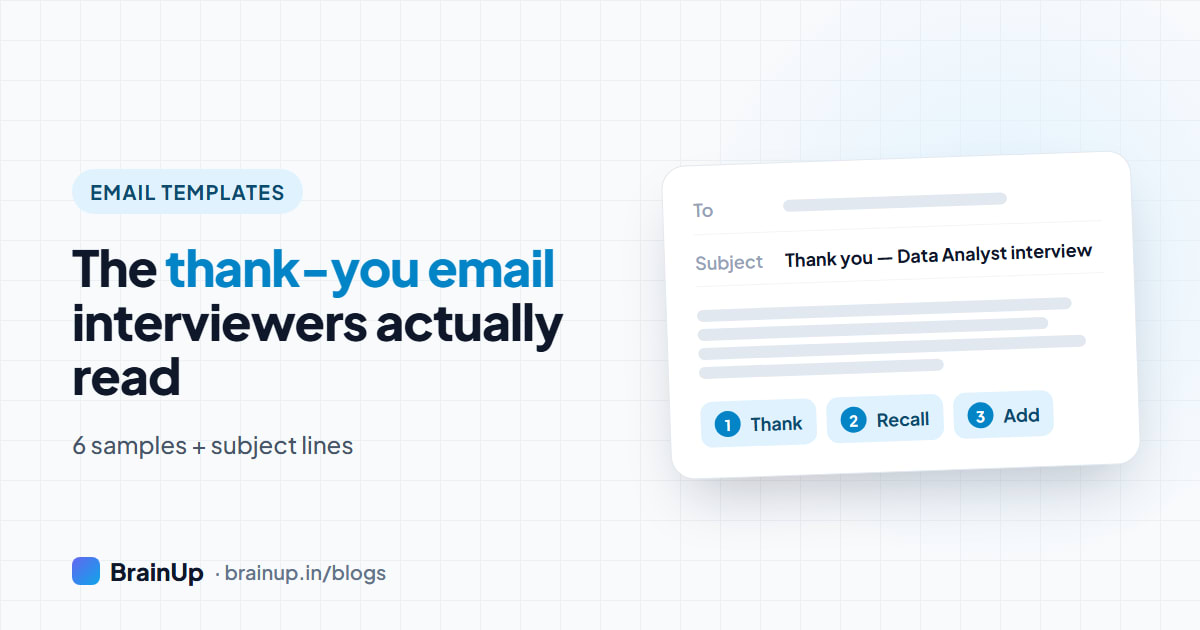
Short answer: Send a short email within 24 hours. Thank the interviewer for their time, recall one specific thing you discussed, and add one line on why you are a good fit or something you forgot to mention. Keep it under 150 words.
Most thank-you emails read the same: “Thank you for your time. I enjoyed our conversation. I look forward to hearing from you.” They are polite, forgettable and deleted in seconds.
A good thank-you email does one more thing: it reminds the interviewer who you are by referring to something only you and they discussed. That takes thirty extra seconds to write and makes the email worth reading.
The Thank–Recall–Add method
| Part | What to write | Example |
|---|---|---|
| Thank | One line of thanks, with the role name | “Thank you for your time today discussing the Backend Developer role.” |
| Recall | A specific moment from the conversation | “I enjoyed hearing how your team moved the payments service to event-driven queues.” |
| Add | A short point of fit, or something you forgot | “I’ve done similar work with RabbitMQ and would love to contribute.” |
Subject lines
- Thank you — [Role] interview
- Thank you for today’s conversation, [Name]
- [Your name] — [Role] interview follow-up
- Great speaking with you about the [Role] role
Keep the role name in the subject. Interviewers often see several candidates for different roles in a week.
6 sample emails
Illustrative samples. Replace the specifics with what was actually discussed.
1. After an HR round
Subject: Thank you — Customer Success Associate interview
Hi Sneha,
Thank you for speaking with me today about the Customer Success Associate role. It was helpful to understand how the team is split by client size, and the focus on long-term relationships matches what I enjoyed most in my internship.
Please let me know if you need anything else from me for the next round.
Best regards,
Riya Sharma
+91 98XXX XXXXX
2. After a technical round
Subject: Thank you — Backend Developer technical round
Hi Arjun,
Thanks for the technical discussion today. I enjoyed the caching problem. Afterwards I realised a write-through cache would have handled the consistency issue we discussed more cleanly than my first approach, and I’ve noted it for next time.
I’m excited about the work your team is doing on the payments platform and hope to continue the conversation.
Regards,
Vikram
3. After a panel interview (one per interviewer)
Subject: Thank you — Marketing Manager panel
Hi Ms. Kapoor,
Thank you for being part of today’s panel. Your question about measuring brand campaigns made me think. I’ve since written down how I’d set up a simple pre/post survey for the Diwali campaign we discussed, and I’d be glad to share it.
Best,
Ananya
4. After a final round with a manager
Subject: Thank you for today, Rohit
Hi Rohit,
Thank you for the conversation today. Hearing your plans to expand into Tier-2 cities made the role even more interesting, since that is where I have spent the last three years building distributor networks.
I’m keen to join the team and look forward to hearing about next steps.
Regards,
Sameer
5. Short version
Subject: Thank you — Graphic Designer interview
Hi Megha, thank you for your time today. I enjoyed walking through the packaging redesign with you, and I’m excited about the chance to work on your festive range. Best, Nikhil
6. After a rejection
Subject: Thank you — Data Analyst role
Hi Pooja,
Thank you for letting me know, and for the time your team spent with me. I learned a lot from the case round. I’d be glad to be considered for future analyst roles.
Best wishes,
Farhan
Weak vs strong
“Dear Sir, Thank you for the interview. I am very interested in the job. Kindly consider my candidature. Regards.”
“Hi Mr. Rao, thank you for today’s interview for the Sales Executive role. Your point about distributor relationships in Nagpur stuck with me, since that is where I’ve built most of my accounts. I’d be glad to bring that network to your team.”
What happens after the thank-you
- Day 0–1: thank-you email.
- After the date they gave you: if you hear nothing, send one polite follow-up asking about the timeline.
- One week after that: a final follow-up, then move your energy to other applications.
Draft follow-up emails faster
Write and refine job emails with BrainUp’s AI Email Tool (beta), then personalise the details yourself.
Try the Email ToolNeed help with the emails before the interview? See how to write an email for sending your resume and a cold email to a recruiter.
Key takeaways
- Send it within 24 hours and keep it under 150 words.
- Recall one specific thing from the conversation.
- Add one line of fit or a point you missed.
- Put the role name in the subject line.
Frequently asked questions
When should I send a thank-you email after an interview?
Within 24 hours, ideally the same day. For a morning interview, sending it in the afternoon works well.
Does a thank-you email really make a difference?
It rarely changes a clear decision, but it can help when candidates are close, and it shows professionalism. A specific note also reminds the interviewer of what you discussed.
Who should I send it to if I had a panel interview?
Send a short individual email to each interviewer if you have their addresses, with a different detail in each. Otherwise send one email to the HR contact and ask them to pass on your thanks.
What if I don’t have the interviewer’s email address?
Send it to the recruiter or HR coordinator who scheduled the interview, or connect with the interviewer on LinkedIn with a short note.
Should I send a thank-you email after a rejection?
Yes, briefly. Thank them, ask to be considered for future roles, and keep it positive. It keeps the door open.