What a career change resume must prove (without inventing a job title)
You open a product-analyst posting. Your last role was “Customer Success Associate.” The gap feels unfair—so the temptation arrives: rename yourself “Junior Product Analyst,” inflate “owned the roadmap,” and hope no one asks for proof.
That shortcut is how career change resumes get rejected twice: once by ATS confusion, once by a recruiter who cross-checks LinkedIn and finds a different story. Invented titles and fake experience do not close a skill gap—they create a trust gap.
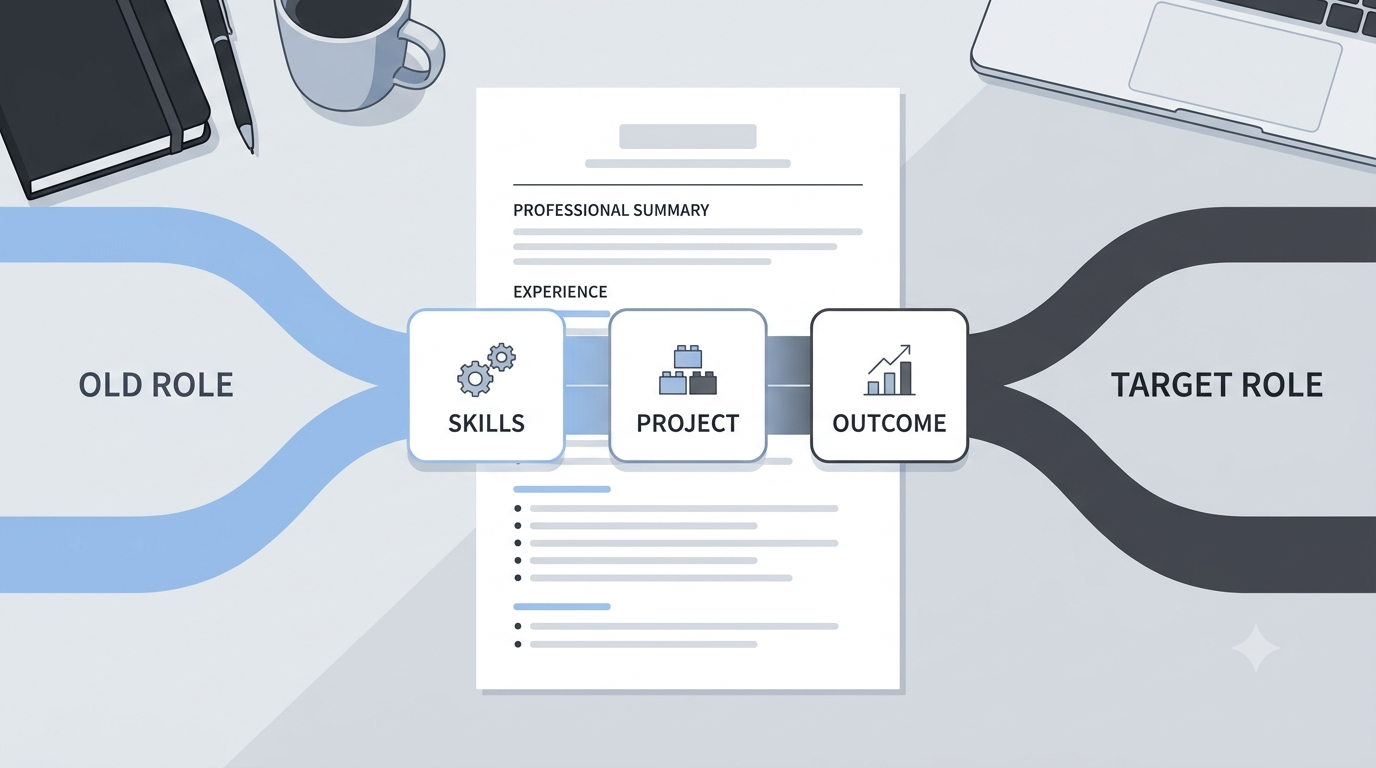
Rebuild the document with the Bridge Map Method: Target signals → Evidence inventory → Bridge bullets → Gap plan. You also get a format decision tree (chronological / hybrid / functional), before/after bridge bullets, a fake-experience detector, and a Summary + Skills + Projects stack for switchers—without promising interview rates or “overnight pivot” myths.
The Bridge Map Method
Most “highlight transferable skills” advice stops at a soft-skills list. A Bridge Map forces you to connect what the job asks for to what you can prove—then rewrite in the target role’s language.
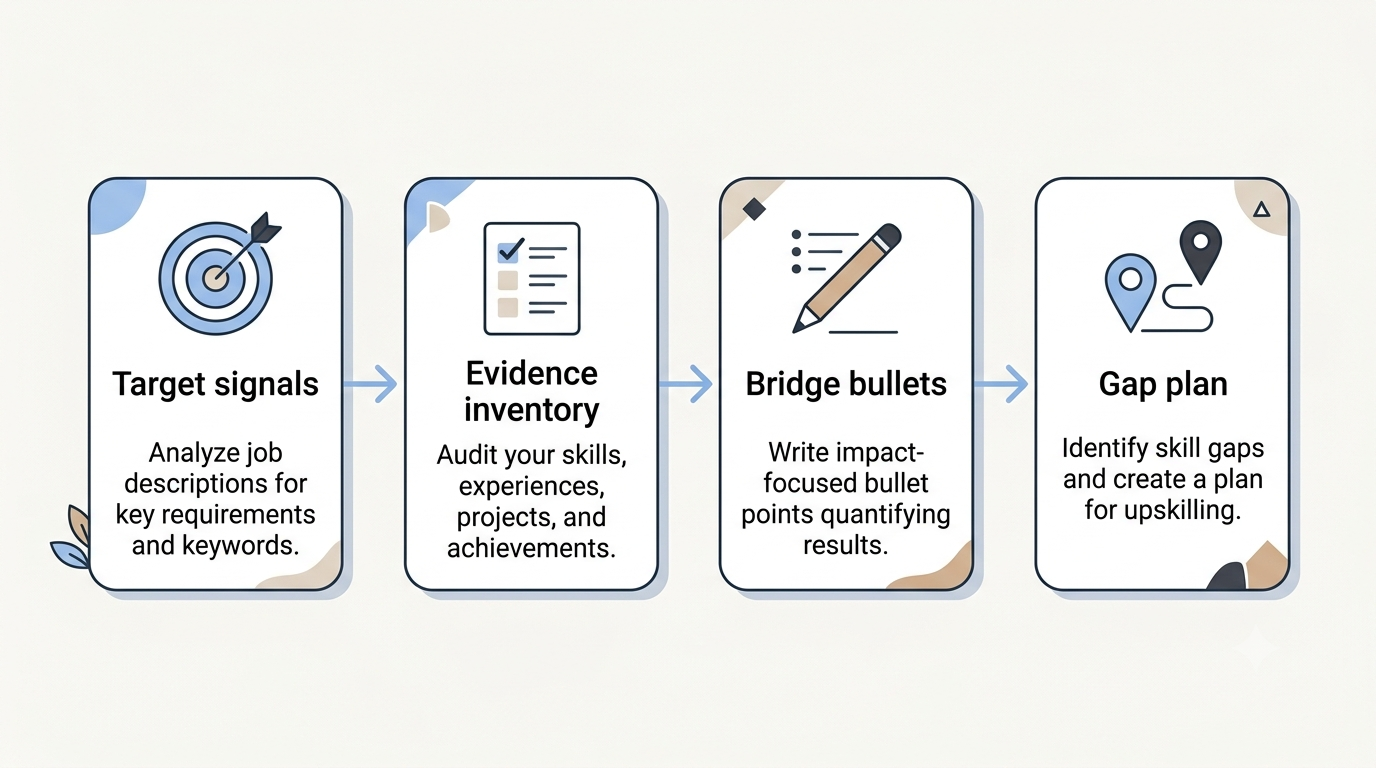
- Target signals — From 1–2 real job descriptions, pull must-have skills, tools, outcomes, and domain nouns (not every buzzword).
- Evidence inventory — List wins from past jobs, projects, volunteering, coursework—each with a verb, scope, and result you can defend.
- Bridge bullets — Rewrite evidence using the target role’s vocabulary while keeping real titles and dates.
- Gap plan — Name 1–3 missing signals and how you are closing them (course, project, volunteer)—without fake experience.
Bridge Map worksheet
Copy this table into a note. Fill one row per target signal before you open your resume editor.
| Step | Prompt | Your notes |
|---|---|---|
| 1. Target signals | What skills, tools, and outcomes appear in the JD (top 6–8)? | ☐ |
| 2. Evidence inventory | Where have you done something adjacent (job, project, volunteer)? | ☐ |
| 3. Bridge bullets | Rewrite each win with target-role nouns + honest metric/scope | ☐ |
| 4. Gap plan | Which signals have weak/no evidence? What will you ship in 2–6 weeks? | ☐ |
When you tailor the resume to a job description, reuse the same Target signals column—do not rebuild from scratch for every apply. For when to keep one base resume vs. role versions, see one resume vs multiple versions.
Format decision: chronological, hybrid, or functional?
A pure functional layout (skills-first, dates de-emphasized) is often pitched to career changers. In practice, many recruiters and ATS workflows still prefer clear employers and dates. University career services often recommend a combination (hybrid) approach that leads with skills while keeping reverse-chronology work history readable—see, for example, NJIT Career Development Services on the combination resume. Treat format as a decision—not a dogma. When in doubt, keep chronology readable and put the bridge in Summary, Skills, and Projects. For post-switch interviews, prep transferable stories with the STAR method.
| Format | Best when | Risk | Career-switch tip |
|---|---|---|---|
| Chronological | Steady employment; titles are adjacent enough to explain | Old titles may “look wrong” at a glance | Lead with Summary + Skills that name the target role; rewrite bullets as bridges |
| Hybrid / combination | Most switchers (default) | Skills dump without proof looks empty | Skills summary up top + chronological roles with bridge bullets |
| Functional | Highly fragmented history; multiple short gigs or long gaps | Recruiters may assume you are hiding something; ATS may parse poorly | Use rarely; still include employers and dates somewhere |
- Can you list employers + dates honestly? → Prefer hybrid or chronological.
- Are titles far from the target but outcomes transferable? → Hybrid with Skills + Projects first.
- Is history fragmented and dates would confuse more than clarify? → Functional skills clusters—but keep a dated employment list.
Section takeaway: Default hybrid/chronological with a skills summary. Pure functional is the exception, not the career-change rule.
Before / after: bridge bullets (and the fake-experience trap)
Bridge bullets keep the same facts. They change the frame—from old job dialect to target-role dialect. For more impact patterns, see resume bullet examples that show impact.
Same job. Clearer operations signal. Still honest.
Why it fails: Interviews and reference checks expose invented titles and metrics. Trust damage ends the switch faster than a thin-but-honest resume.
Draft the bridge version in a live editor
After your Bridge Map rows are filled, rebuild Summary, Skills, and bullets in the BrainUp Resume Builder. Use it as a draft workspace with live preview—not a guarantee of interviews. Advanced AI tabs may require login or subscription.
Open Resume BuilderSummary + Skills + Projects stack for switchers
Chronology alone often buries the bridge. Stack three sections above (or tightly around) Experience so the target role is obvious in the first screen.
1. Summary (target-first, proof-second)
Names the target, cites transferable proof, owns the pivot—no fake “Data Analyst at…” line.
2. Skills (signal clusters, not soft-skill soup)
- Group by tools, methods, and domain the JD uses.
- Only list skills you can discuss for 60 seconds with an example.
- Mirror JD nouns carefully—see how to pull ATS keywords from a job description without stuffing, and build the list with the Signal Stack skills section method.
3. Projects (close the gap in public)
Projects are where switchers earn missing signals without inventing jobs. One strong project beats five vague “familiar with” claims.
- Problem → what you built → tools → result (even qualitative).
- Link a repo, Notion case study, or slide deck only if it is viewable and yours.
- Align project titles with Target signals from your Bridge Map.
Where the cover letter carries the “why”
Your resume should not confess every motivation paragraph. The cover letter is the place to say why you are switching and how the Bridge Map connects. Keep claims identical: same titles, same dates, same metrics.
Pair the resume with a switcher cover letter
Once bullets are honest, draft a short letter that explains the bridge—not a second resume. Try the BrainUp Cover Letter Builder as a structured editor. Treat AI Assist features as evolving; focus on a clear, truthful narrative.
Open Cover Letter Builder60-minute career-change resume rewrite
- 10 min: Paste one target JD; extract 6–8 Target signals.
- 15 min: Fill Evidence inventory (jobs + projects).
- 20 min: Rewrite 5 bridge bullets; run the fake-experience detector.
- 10 min: Rebuild Summary + Skills + one Projects block (hybrid layout).
- 5 min: Write Gap plan (1–3 items) for the cover letter or interview.
Revisit the Bridge Map when you change target lanes. A resume for “operations” and one for “product support” may share history but need different signal columns.
FAQ
How do I show a career change on my resume?
Use the Bridge Map Method: extract target-role signals from the job description, inventory honest evidence from past work and projects, rewrite bridge bullets in the new role’s language, then list a short gap plan for missing skills. Lead with a target-focused summary and skills section; keep real job titles and dates.
Should I use a functional or chronological resume for a career change?
Default to chronological or hybrid (combination) with a strong skills summary and bridge bullets. Pure functional formats are often pitched for switchers, but many recruiters and ATS workflows prefer clear dates and employers. Use pure functional only if your history is unusually fragmented—and still include dates somewhere.
How do I list transferable skills without sounding generic?
Pair each skill with evidence: a tool, context, outcome, or scope from real work. “Communication” alone is weak; “Ran weekly stakeholder demos for 4 product teams” is a bridge. Map skills to the job description’s language, then prove them in bullets and projects.
Can I change my job title on my resume for a career switch?
Keep the official title you held. You may add a clarifying parenthetical or a bridge line under the role (for example, “focus: customer research & journey mapping”) if it is truthful. Inventing a target-role title you never held is a fake-experience risk—recruiters and background checks catch title inflation.
What if I have no experience in the new field?
You still have transferable outcomes, adjacent tools, projects, coursework, volunteering, or freelance work. Put those in Summary, Skills, and a Projects section. Be honest about the gap in your cover letter and Gap plan—do not invent employers or metrics. A rebuilt narrative helps; it does not guarantee interviews or offers.
Should my career-change resume and cover letter tell the same story?
Yes. The resume proves transferable outcomes; the cover letter explains why you are switching and how your Bridge Map connects old work to the target role. Keep titles, dates, and claims identical across both documents.