Short answer: State your contractual notice period exactly, say whether early release or a buyout is possible, and give a realistic earliest joining date. Do not shorten your notice period to sound attractive; it is usually verified.
In India, the notice period question often decides whether your profile moves forward at all. A recruiter with an urgent opening may skip a strong candidate on a 90-day notice and pick a slightly weaker one who can join in 30. That pressure tempts people to bend the truth, which almost always backfires at the offer or background check stage.
You can be honest and still sound like a good bet. Here is how.
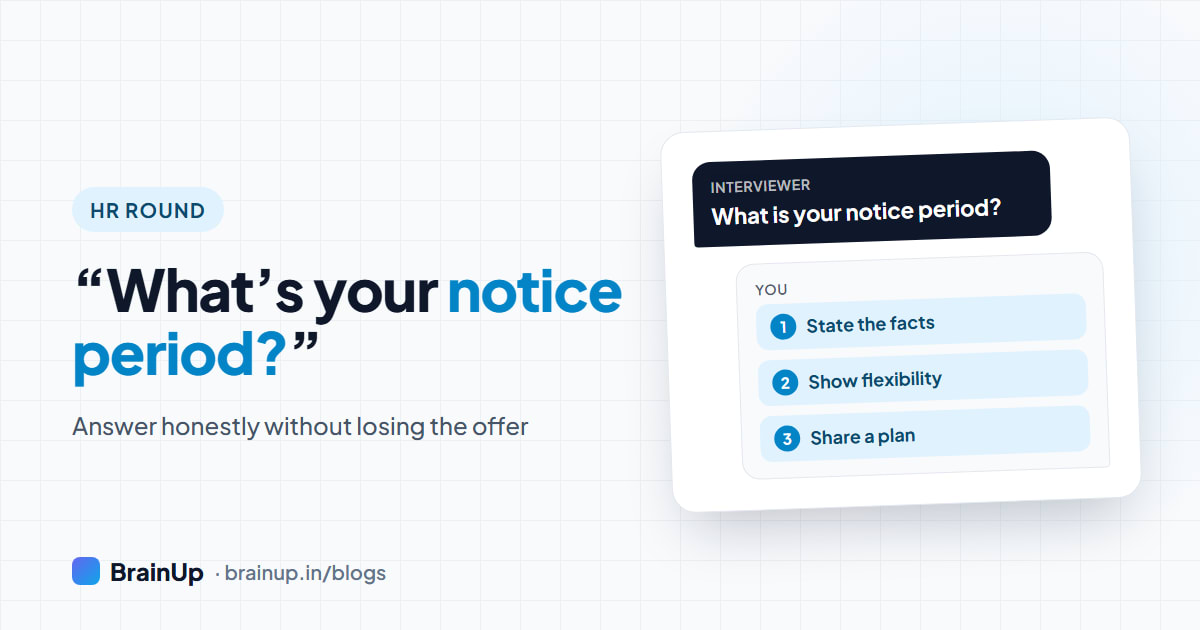
The State–Flex–Plan method
- State the contractual notice period and your status (not resigned, resigned, or serving notice).
- Flex: say what can shorten it, such as early release, leave encashment or a buyout.
- Plan: give the earliest realistic joining date and how you will make it happen.
“My notice period is 60 days. I haven’t resigned yet. In my company, early release is possible if the handover is complete, so I’d plan to wrap up my projects in about 45 days. Realistically I could join in 45 to 60 days from the offer.”
Answers by notice period
Illustrative answers. Use your real situation.
| Your situation | Sample answer |
|---|---|
| Fresher / no current job | “I can join immediately. My final exams end on 20 May, so any date after that works.” |
| Immediate joiner (between jobs) | “I’m available to join immediately. My last working day was 15 September.” |
| Serving notice | “I’ve already resigned. My last working day is 30 November, so I can join from 1 December.” |
| 30 days | “My notice period is 30 days. I can start the day after I accept the offer and resign.” |
| 60 days | “It’s 60 days, but early release is possible after handover. I’d aim for 45 days.” |
| 90 days | “My notice is 90 days. A buyout is allowed under my contract, and I’m open to discussing it if your timeline is tight.” |
Notice period buyout, explained
A buyout means paying your current employer for the notice days you will not serve, typically based on your basic salary for those days. The exact calculation depends on your appointment letter.
- Who pays? Sometimes you, sometimes the new employer (often reimbursed through a joining bonus). Ask the recruiter directly: “Does your company support notice buyout?”
- Is it guaranteed? No. Some employers do not allow buyout for certain roles. Check your contract before offering it.
How to request an early release
If the new employer wants you sooner, ask your manager early and make the handover easy to say yes to.
Subject: Request for early release — handover plan attached
Hi Priya,
Following my resignation dated 1 October, I’d like to request an early release on 15 November instead of 30 December. I’ve attached a handover plan covering my three active projects, documentation, and a two-week overlap with Rohan, who will take over the vendor reports.
I’m happy to stay reachable for questions for two weeks after I leave. Please let me know if this works or if you’d like changes to the plan.
Thanks,
Aman
Do and don’t
| Do | Don’t |
|---|---|
| Quote your contractual period exactly | Say 30 days when it is 90 |
| Mention buyout or early release only if your contract allows it | Promise a joining date you cannot control |
| Update your notice status on job portals when you resign | Leave “immediate joiner” on your profile when it is not true |
| Keep the new employer posted if your release date changes | Go silent between offer and joining |
The notice period question and salary
A long notice period can weaken your negotiating position slightly, and an urgent opening can strengthen it. If the recruiter asks you to join quickly, that is a fair moment to discuss buyout support or a joining bonus. See our salary negotiation guide for how to raise it.
Your notice period answer should also line up with why you are leaving. When you finally resign, our resignation letter format helps you do it cleanly.
Juggling several offers and joining dates?
Track every application, interview round and joining date in one place with BrainUp’s Job Application Tracker.
Open the Job TrackerKey takeaways
- State your real notice period and your status.
- Mention early release or buyout only if your contract allows it.
- Give a realistic earliest joining date.
- Never shorten your notice period to sound better; it is usually verified.
Frequently asked questions
What should a fresher say when asked about notice period?
Say you can join immediately or from a specific date, such as after your final exams or convocation. If you have an internship ending, give that end date.
Is it okay to lie about my notice period?
No. Companies usually check it with your current employer or relieving letter, and offers can be withdrawn. State the real period and show flexibility instead.
What is a notice period buyout?
A buyout means paying your current employer the salary for the days of notice you will not serve, so you can leave early. Sometimes the new employer covers it; it depends on their policy and your employment contract.
Can my notice period be reduced?
Often yes, if you hand over your work well and ask early. Many managers agree to an early release if the handover is clean. Your contract and company policy decide what is possible.
What does “serving notice period” mean on Naukri?
It means you have already resigned and are working out your notice. Recruiters often prioritise these profiles because the joining date is more certain.