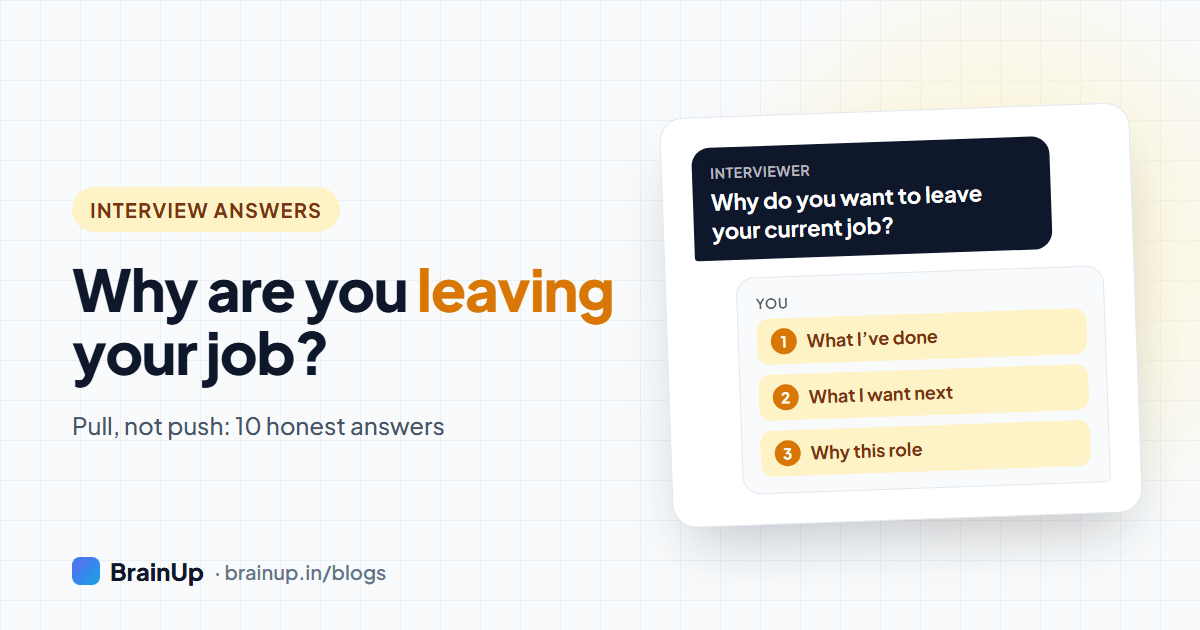
Short answer: Talk about what you are moving toward, not what you are running from. Briefly say what you have achieved in your current role, name the growth or change you want next, and connect it to this job. Never criticise your current employer.
You might be leaving because of a difficult manager, a stalled salary, or a company that stopped growing. All of those are valid reasons. The problem is that saying them directly in an interview makes you sound like a complainer, and interviewers worry you will talk about them the same way one day.
The fix is not to lie. It is to describe the same move from the other direction.
The Pull, Not Push method
Push reasons are things you want to escape. Pull reasons are things you want to move toward. Almost every push reason has an honest pull version.
| The real push reason | The honest pull version |
|---|---|
| My manager micromanages | I’m looking for more ownership of my work |
| No salary hike in two years | I want a role with more responsibility and pay that matches it |
| The work is boring | I’ve mastered my current scope and want harder problems |
| The company is struggling | I want to work somewhere that is investing in this area |
| Long commute / location | I’m relocating / I want to work closer to home in Bengaluru |
| No learning, no mentoring | I want a team where I can learn from more experienced people |
The structure
- Credit the current role (one sentence): what you learned or achieved.
- Name the pull (one or two sentences): what you want next.
- Connect to this job (one sentence): why this role offers it.
Total: 30–45 seconds. This is not a question to dwell on.
10 sample answers
Illustrative examples. Use the one closest to your real reason and adjust the details.
“I’ve learned a lot in three years at my current company, especially in handling key accounts. I’m now ready to manage a larger portfolio, and this role offers exactly that.”
“I’ve become comfortable with everything in my current scope. I want to work on systems at a bigger scale, which is why your platform team interests me.”
“I’m the only designer at my current startup, which taught me to be self-reliant. I now want to work in a design team where I can learn from senior designers.”
“I’ve worked in IT services and enjoyed it, but I want to build a product I can see grow over time. Moving to a product company is a deliberate step for me.”
“My responsibilities have grown a lot, but the role and pay haven’t kept up. I’m looking for a position where both match the work I’m doing, and this one does.”
“I’m moving to Pune for family reasons, so I’m looking for a strong team here. Your company was on my list even before the move.”
“My company is shifting focus away from analytics, which is the area I want to grow in. Your team is investing heavily in it.”
“The role turned out to be mostly data entry rather than the analysis work discussed at hiring. I gave it a fair try for eight months and learned Excel deeply, but I want to do the analysis work I trained for.”
“My role was part of a company-wide restructuring that affected about a third of the team. I’m proud of what I delivered there, and I’m now looking for a stable team where I can build for the long term.”
“My contract with the client project ends next month. It gave me solid experience with SAP rollouts, and I want a permanent role where I can keep building on it.”
Phrases that raise red flags
“My manager is terrible.” · “The company is a mess.” · “I just need a change.” · “I’m only here for the hike.” · “I got bored.”
Each one either blames others or suggests you will leave this job just as quickly.
Keep your story consistent
Interviewers often connect this answer to two others:
- Your notice period. If you say you are relocating next month, but your notice period is 90 days, explain the gap.
- Your five-year plan. Your reason for leaving should point in the same direction as where you see yourself in five years.
Practise the tricky questions
Rehearse job-change and career questions for your target role with BrainUp’s AI Interview Prep (beta).
Try AI Interview PrepKey takeaways
- Describe what you are moving toward, not away from.
- Credit your current role in one sentence before moving on.
- Short tenures, layoffs and money reasons are fine when stated calmly and briefly.
- Never criticise your employer or manager.
Frequently asked questions
Is it okay to say I’m leaving for a better salary?
Yes, if it is part of the picture and you say it calmly. Pair it with growth: “I’m looking for a role with more responsibility, and the compensation that comes with it.” Avoid making money the only reason.
How do I explain leaving a job within one year?
Be brief and factual about what changed (role mismatch, project ended, relocation), say what you learned, and explain why this new role is a better long-term fit. Do not blame the employer.
What if I was laid off?
Say it plainly: “My role was part of a company-wide restructuring.” Layoffs are common and not a reflection on you. Then move quickly to what you are looking for next.
What if I was fired?
Do not lie, because it can surface in background checks. Keep it short, take responsibility for your part, and explain what you changed: “The role wasn’t a good fit for my strengths. I’ve since focused on roles that use my client skills.”
Can I say I don’t like my manager?
Avoid it. Even if true, it makes the interviewer wonder how you will talk about them later. Reframe it as what you are looking for, such as more feedback or clearer ownership.