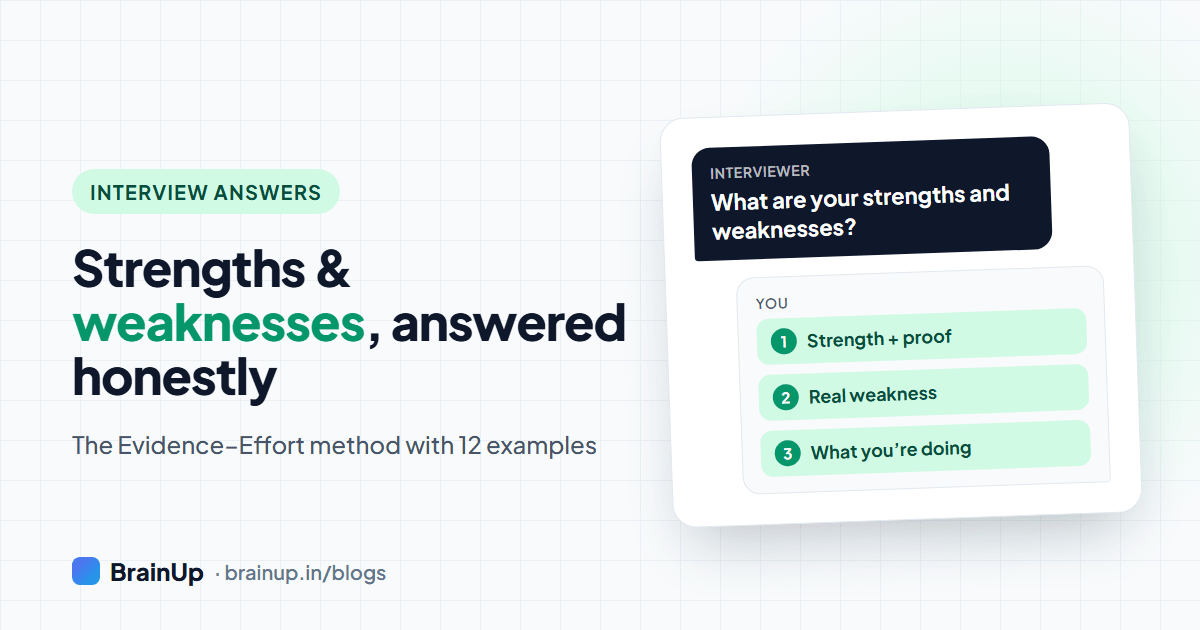
Short answer: Name one strength the job needs and prove it with a short example. Then name one real weakness that is not central to the role, and explain the specific steps you are taking to improve it. Honest and specific beats polished and vague.
“What are your strengths and weaknesses?” feels like a trap because it asks you to praise yourself and criticise yourself in the same breath. Most people respond with the same safe lines: “I’m hardworking” and “I’m a perfectionist”. Interviewers hear those all day, and they learn nothing from them.
The question is really about self-awareness. Can you see what you are good at, can you see where you fall short, and do you do something about it? Here is a method that answers all three.
The Evidence–Effort method
Your strength needs evidence. Your weakness needs effort. That is the whole method.
| Strength | Weakness | |
|---|---|---|
| Name it | One strength the job needs | One real weakness that is not core to the job |
| Show it | A short example where it made a difference | A short example of when it caused a problem |
| Close it | How it would help in this role | What you are doing about it, and progress so far |
Each half should take about 30–45 seconds. Together, aim for around 90 seconds.
Choosing your strength
Start from the job description, not from your personality. Pick the strength the job needs most, then check you have an example. If you have no example, pick the next one.
| Type of role | Strengths that usually matter |
|---|---|
| Software, data, engineering | Problem-solving, debugging patiently, learning new tools fast, attention to detail |
| Sales, business development | Persistence, listening, building trust, handling rejection |
| Operations, admin, accounts | Organisation, accuracy, following through, process improvement |
| Design, content, marketing | Turning feedback into better work, clarity, consistency under deadlines |
| Customer support, HR | Patience, empathy, calm under pressure, clear communication |
Our resume strengths examples page has more ideas. Use the same strength on your resume and in the interview so the story stays consistent.
Choosing your weakness: the safety filter
A good weakness passes three tests:
- It is real. If you invent one, it will sound invented.
- It is not core to the job. “I struggle with numbers” is fatal for an accountant and harmless for a graphic designer.
- You are already working on it. You can name a concrete step and some progress.
Weaknesses to avoid
| Avoid | Why |
|---|---|
| “I’m a perfectionist” / “I work too hard” | Heard constantly, sounds like a dodge |
| “I don’t have any weaknesses” | Signals low self-awareness |
| A core skill of the role | Gives them a reason to reject you |
| Integrity issues (missing deadlines, cutting corners) | Trust is hard to rebuild in one interview |
| Personal life problems | Not relevant and can create unfair bias |
12 examples you can adapt
These are illustrative. Replace the details with your own real experience.
Strengths for freshers
“I pick up new tools quickly. For my final-year project we had to use Flutter, which none of us knew. I spent the first week on the official docs and a small practice app, and ended up building most of the screens.”
“I finish what I start. As fest coordinator I owned sponsor follow-ups, kept a simple tracker, and closed all five sponsors we had shortlisted before the deadline.”
“I’m good at explaining technical things simply. I ran weekly doubt-clearing sessions for juniors in data structures, and attendance grew through the semester.”
Strengths for experienced candidates
“I fix recurring problems instead of firefighting them. Our month-end reconciliation used to take four days; I built a checklist and two Excel templates, and it now takes two.”
“I keep stakeholders aligned. On our last release, I sent a short weekly status to sales and support, and we had no surprise escalations at launch.”
“During peak season I handled the escalation queue alone for two weeks. I triaged by impact, kept customers informed, and cleared the backlog without missing an SLA.”
Weaknesses for freshers
“I sometimes try to solve things alone for too long. In my internship I lost a day on a setup issue my mentor fixed in ten minutes. Now I give myself a time limit, usually an hour, before I ask.”
“Presenting to large groups makes me nervous. I joined my college’s speaking club and volunteered to present our project at the department review. It still takes effort, but I prepare better and it shows.”
“I can spend too long researching before starting. I now set a research deadline and start with a rough first version, then improve it.”
Weaknesses for experienced candidates
“When I first led a small team, I held on to tasks I could have delegated. I now assign by default and review, rather than doing it myself, and the team’s output went up.”
“I used to accept every request, which stretched my deadlines. I now check priorities with my manager before committing and say no with a reason when needed.”
“My SQL is basic compared to my Excel. I’m doing an online SQL course and practising on our team’s reporting data every week.”
Putting it together: a full answer
“My main strength is patience with people who are frustrated. During my internship at a telecom helpdesk I handled billing complaints, and I learned to let customers finish before I explained anything. My supervisor started routing the harder calls to me in the last month.
A weakness is that I take too long to ask for help. Early on I spent a whole afternoon on a refund process I didn’t understand. Now I give myself a time limit before I ask a teammate, and it has made me faster and less stressed.”
Common mistakes
- Listing five adjectives. Pick one strength and prove it.
- A weakness with no fix. Without the effort part, a weakness is just a problem.
- Over-apologising. State the weakness plainly and move to what you are doing.
- Contradicting your resume. If your resume says “strong communicator”, do not pick communication as your weakness.
This question pairs naturally with “Why should we hire you?”. Use the same core strength in both answers. For a broader list, see interview questions for freshers.
Practise your answers out loud
Rehearse strengths, weaknesses and other common questions for your target role with BrainUp’s AI Interview Prep (beta).
Try AI Interview PrepKey takeaways
- Strength = one quality the job needs + an example that proves it.
- Weakness = something real, not core to the role, with concrete steps you are taking.
- Skip clichés like “perfectionist”; specific and honest wins.
- Keep the whole answer around 90 seconds.
Frequently asked questions
How many strengths and weaknesses should I mention?
One of each, explained well, is better than a list. If the interviewer asks for three, give three short ones but expand only on the first.
What is a good weakness for a fresher?
Something real that does not block the core job, plus proof you are working on it. Examples: hesitating to ask questions in a new team, over-researching before starting a task, or limited experience presenting to large groups.
Is “I’m a perfectionist” a good weakness?
Usually not. Interviewers hear it constantly and read it as a dodge. If perfectionism is genuinely your issue, describe the concrete behaviour (for example, revising slides past the deadline) and what you changed.
Should my strength match the job description?
Yes. Pick the strength that the job needs most and that you can prove with an example. A strength that does not matter for the role is wasted airtime.
What weaknesses should I never say in an interview?
Anything that is a core requirement of the role, anything about integrity (lying, missing deadlines habitually), and personal issues unrelated to work. Use the safety filter in this article before you choose.