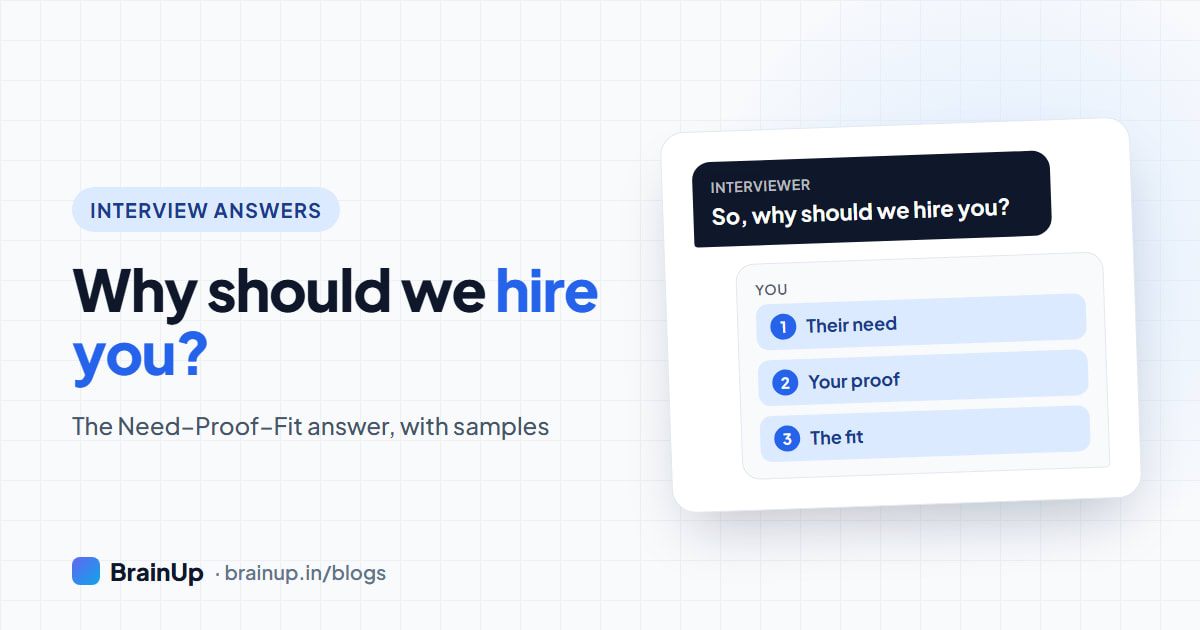
Short answer: Name the one or two things this role needs most, give specific proof that you have done them (a result, project or number), and close with why this job fits your next step. Keep it to 60–90 seconds and build it from the job description, not from a list of your adjectives.
You have answered “Tell me about yourself”. The interviewer nods, leans back, and asks: “So, why should we hire you?” Most candidates freeze here because the question sounds like an invitation to brag. It is not. It is a test of whether you understood the job.
The interviewer already has your resume. What they want to hear is whether you can connect their problem to your evidence without being prompted. This guide gives you a method for doing exactly that, with sample answers for freshers, experienced candidates and career switchers.
What the interviewer is really checking
Behind the question are three quieter ones:
- Did you read the job description? Generic answers (“I’m hardworking and a team player”) tell them you did not.
- Can you back up a claim? Anyone can say “I’m good at Excel”. Few people say “I built the weekly sales tracker my team still uses”.
- Will you stay and grow here? A good answer ends with why this role makes sense for you, which lowers the risk of hiring you.
The Need–Proof–Fit method
Every strong answer to this question has three parts, in this order.
| Part | What you say | Time |
|---|---|---|
| 1. Need | The one or two things this role clearly needs, in their words from the job description. | 10–15 sec |
| 2. Proof | One or two specific examples that show you have done that work, ideally with a result. | 35–50 sec |
| 3. Fit | Why this role is the logical next step for you, and what you will do in the first months. | 15–20 sec |
Starting with their need is what makes the answer feel tailored. Most candidates start with themselves (“I am a dedicated professional…”), which sounds rehearsed even when it is true.
Step 1: Find the need in the job description
Open the job description and underline every requirement. Then pick the two that appear most often or sit at the top of the list. Those are what the hiring manager worries about. If the description repeats “stakeholder communication” three times, that is your Need.
Step 2: Pick proof, then rank it
Not all evidence is equally convincing. Use this proof strength ladder and pick the highest rung you can honestly reach:
- Measured result: “Cut report preparation from two days to three hours.”
- Shipped output: “Built and deployed a college event registration app used by 400 students.”
- Responsibility held: “Handled vendor follow-ups for three ongoing projects.”
- Skill learned with a project: “Learned SQL by analysing a public sales dataset and wrote up the findings.”
- Trait claim: “I’m a quick learner.” Use only as a bridge, never as the proof itself.
Freshers usually live on rungs 2 to 4. That is fine. A specific rung-4 example beats a vague rung-1 claim every time.
Step 3: Close with fit
End by explaining why this job, at this company, is your next step. Keep it forward-looking: what you want to get better at and what you would contribute early. This reassures the interviewer that you are not just applying everywhere.
Sample answers you can adapt
All three samples below use the same method. They are illustrative; swap in your real role, projects and numbers.
Fresher (B.Tech graduate, junior data analyst role)
“From the job description, the two things this role needs most are clean SQL reporting and explaining numbers to non-technical teams. In my final-year project I built a dashboard on three years of a retailer’s public sales data. I wrote the SQL to clean about 50,000 rows, built the views in Power BI, and presented the findings to a panel of faculty who had no data background. The feedback I got was that the story was easy to follow, which is the part I enjoyed most.
This role is exactly the next step I’m looking for: real business data, and people who will use what I build. In my first few months I’d want to learn your reporting stack properly and take over at least one recurring report end to end.”
Experienced (sales executive moving to a larger company)
“You’re hiring to grow accounts in the Pune region, and the JD stresses new client acquisition. Over the last two years I’ve been doing that in a smaller territory: I added 18 new B2B accounts, and the ones I onboarded had the best renewal rate in my team last year because I stay involved after the sale.
I’m ready for a bigger territory and a stronger product, and your client list is the kind I want to work with. I’d spend the first month meeting existing accounts before chasing new ones, so I know where the growth actually is.”
Career switcher (teacher moving into instructional design)
“This role needs someone who can turn complex material into learning people finish. That has been my job for six years as a teacher. I redesigned our Class 9 science unit into short modules with quizzes after each one, and completion of homework went up noticeably that term. I’ve since completed an instructional design course and built two sample e-learning modules in Articulate, which are in my portfolio.
Moving into corporate learning is a deliberate step for me, and I’d bring classroom-tested instincts about where learners drop off.”
Weak answers and how to fix them
“You should hire me because I am hardworking, passionate, a quick learner and a good team player.”
“The role needs someone who can pick up your CRM quickly. In my internship I learned Zoho CRM in my first week and was logging all my team’s leads in it by the end of the month.”
The weak version lists four traits with no evidence. The stronger one picks one trait that matters for this job and proves it.
“I really need this job and I will work very hard.”
Need is not a reason to hire. Replace it with what you will contribute.
“I’m better than the other candidates you’re interviewing.”
You have not met them. Talk about your evidence, not theirs.
Worksheet: build your answer in 15 minutes
Fill this in for each job you interview for. It takes less time than rehearsing a generic answer.
| Prompt | Your notes |
|---|---|
| Top two needs from the JD (their words) | 1. ______ 2. ______ |
| Best proof for need 1 (which ladder rung?) | ______ |
| Best proof for need 2 (optional) | ______ |
| Result or outcome I can state | ______ |
| Why this role is my next step | ______ |
| What I’d do in the first 90 days | ______ |
Once it is filled in, say it out loud with a timer. If you go past 90 seconds, cut the second proof point first.
How this answer connects to the rest of your interview
“Why should we hire you” rarely comes alone. It usually follows “Tell me about yourself” and often comes before “What are your strengths and weaknesses?”. Keep them consistent: the strength you mention later should be one of the proofs you used here. For a wider list, see our common interview questions and answers.
Rehearse it before the real interview
Practise this question and others for your target role with BrainUp’s AI Interview Prep (beta).
Try AI Interview PrepKey takeaways
- Start with the employer’s need, taken from the job description.
- Back it with one or two specific pieces of proof, ideally with a result.
- End with why this role is your logical next step.
- Keep it to 60–90 seconds and rebuild it for every job.
Frequently asked questions
How long should my answer to “Why should we hire you?” be?
Aim for 60 to 90 seconds when spoken, which is roughly 150 to 220 words. Shorter sounds unprepared; longer turns into a second “tell me about yourself”.
What should a fresher say when asked “Why should we hire you?”
Use proof you already have: a project, internship, competition, or coursework that matches one need in the job description. Name the need, show what you built or did, and say why you will ramp up fast. Do not apologise for lacking experience.
Can I answer “Why should we hire you?” in 5 points?
You can, but five points usually sounds like a list of adjectives. Three parts work better: what the role needs, one or two pieces of evidence that you can do it, and why this role fits where you are going.
How is this different from “Why are you a good fit for this position?”
They are the same question in different words. Both ask you to connect the employer’s need to your evidence, so the Need–Proof–Fit answer works for either.
Should I compare myself to other candidates?
No. You do not know the other candidates, and putting them down sounds insecure. Talk about what you bring to this role, with evidence.